

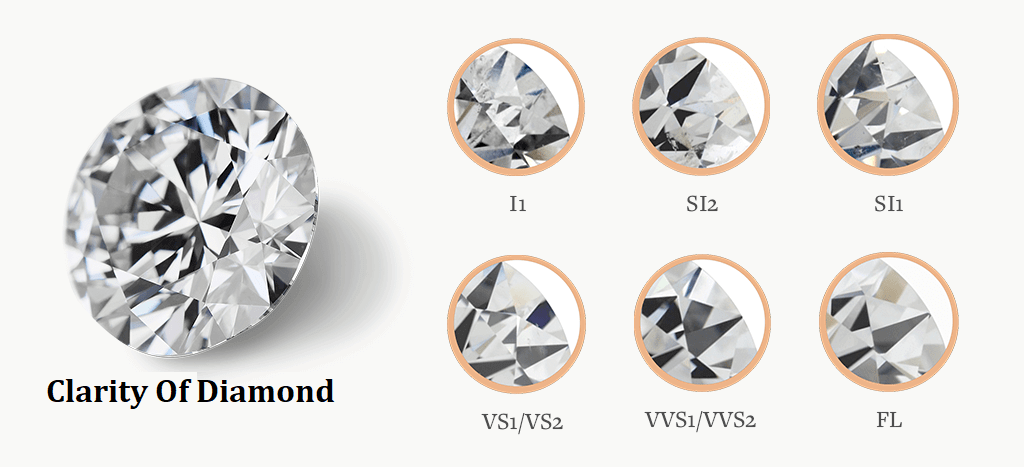
The second C in our series on the 4C’s of diamonds will guide you through the clarity or “Clarity” of a diamond. The clarity is an important part and, in addition to the color, also has a very large influence on the price of a diamond.
What is the Clarity Of Diamond?
Diamonds are graded in purity based on the number of internal impurities, also called inclusions or inclusions called, and the number of surface defects in English terminology blemishes is called. Moreover, it is important whether or not the inclusions and errors are visible with the naked eye, only with the magnifying glass or not even with the magnifying glass.
When you’re presented with a certificate of a diamond for the first time, the way the clarity is displayed can seem particularly complex. This is due to the terminology often used among diamond merchants. For example, they often start to name the inclusions and surface defects with the following terms. Because certificates are often drawn up in English, we have also included the English translations
Inclusions (inclusions):
- Clouds (clouds of feathers)
- Embedded crystals (included minerals)
- Cavities (knots or cavities)
- Splits (cleavage or bearding)
- Internal grains (internal graining)
- Laser lines (laser lining)
- Surface flaws (blemishes):
- Pollijstlijnen (polish lines)
- Grain boundaries (grain boundaries)
- Scratches (naturals or scratches)
- Fractions (nicks or breaks)
The Relationship Between Purity and Price
The same standard must be used for judging diamonds all over the world. That is why the purity scale was created by the Gemological Institute of America (GIA) and is now universally used. This scale ranges from F (perfectly pure) to I3 (large inclusions). Below you will find the scale and we briefly explain what this means. The impurities were marked in red in this example to make them more visible. Of course, this is much less clear in real life, and in most cases, it will be difficult for an untrained eye to see these impurities.
F – Flawless (perfectly pure) is the rarest purity, it represents absolute perfection. The diamond does not have any inclusions or blemishes visible to a trained professional with a magnifying glass (magnification factor x10). When you buy in this category you can be sure that the price will be extremely high, even more than double the VVS category described below.
IF – Internally Flawless
It is also considered very rare. At this purity, there are no inclusions and only minor surface flaws that only a professional can detect with a magnifying glass. The price is also considerably high, but already a lot less than the perfect diamond just now.
VVS1 – VVS2 – Very slight inclusion.
The price immediately drops significantly when inclusions are found in a diamond, however minimal. With a VVS1 or VVS2 diamond, the inclusions are barely visible to a professional with a magnifying glass, but they are there. This quality is often used by leading jewelry brands and in jewelry with large stones.
VS1 – VS2 – Very slight inclusions.
A professional will certainly be able to detect this with a magnifying glass, but the quality of the stone is still very high. Because the price is considerably lower than with the previous purities, but the brilliance is still preserved, this is a widely used quality of diamond in the jewelry sector.
SI1 – SI2 – Small inclusion.
In the SI category, the inclusions are already a bit heavier and more visible, but still only with a magnifying glass. The inclusions still have almost no influence on the brilliance of the diamond. This quality is regularly used when a jewel contains many small stones.
OTHER PURITIES
I1 – I2 – I3 – Included (inclusions).
The lowest quality is the I series. As you can guess, the price of this diamond is very low, but there is a reason for that. The inclusions in this category are often large enough to be seen with the naked eye. With the I1 quality, the brilliance of the diamond will still be beautiful, but with I2 and I3 the inclusions can be so large that they hinder the reflection of the light in the diamond. This quality is rarely used in the jewelry industry.
When we make diamond jewelry at Gemistone Jewelers, we usually do not go lower than the US quality. Of course, the customer is king and we always look for the most beautiful stone for your budget. If you want a larger stone without adjusting your budget, we can also look for diamonds that are lower on the clarity scale.
DIAMOND BUYING TIPS
In addition to the color, you can also play with the clarity of diamonds to purchase on a budget. We give you some tips:
F and IF bricks are very expensive. If you want to buy a diamond as an investment, you can opt for these purities. However, if you want to process the diamond in a jewel, an F or IF stone does not immediately offer added value, especially in terms of brilliance and “bling effect”. It is better to opt for lower quality and somewhat larger stone.
As with the color, and inclusion is more visible with a larger stone. If you go to stones of 1 carat or more, and your budget allows it, we recommend not going lower than the VS2 category. This is possible for smaller stones. For example, a pavé setting is often made with SI quality.
The I category may have visible inclusions, but this does not necessarily mean that this is an ugly stone. When the stone is well cut and the inclusions are not too central. You can sometimes still find a very nice stone of this quality for a very good price.
Are you interested in a beautiful diamond and their diamond jewelry or do you want to propose to the woman of your life with a beautiful diamond engagement ring? Then we will certainly help you further! We will work with you to find the diamond that fits your budget. Do you have any questions or comments? Do not hesitate to contact us via +91 785-999-2163 or by mail at admin@gemistone.com
View more information click here; https://codecalibres.com/