


Recently, 5G satellite communication has suddenly become a hot topic and has received a lot of attention from the industry. The updated 5G standard 3GPP Release 17 is expected to be finalized in the first half of next year. Non-Terrestrial Networks (NTN) will formally become a new component. Non-terrestrial communication networks mainly refer to networks that communicate with the ground via satellites. In fact, non-terrestrial communication networks have been studied as early as 3GPP Release 15. Finally, a non-terrestrial communication network supporting satellite communication was added in 3GPP Release 17. This is an important milestone for the promotion of satellite communications.
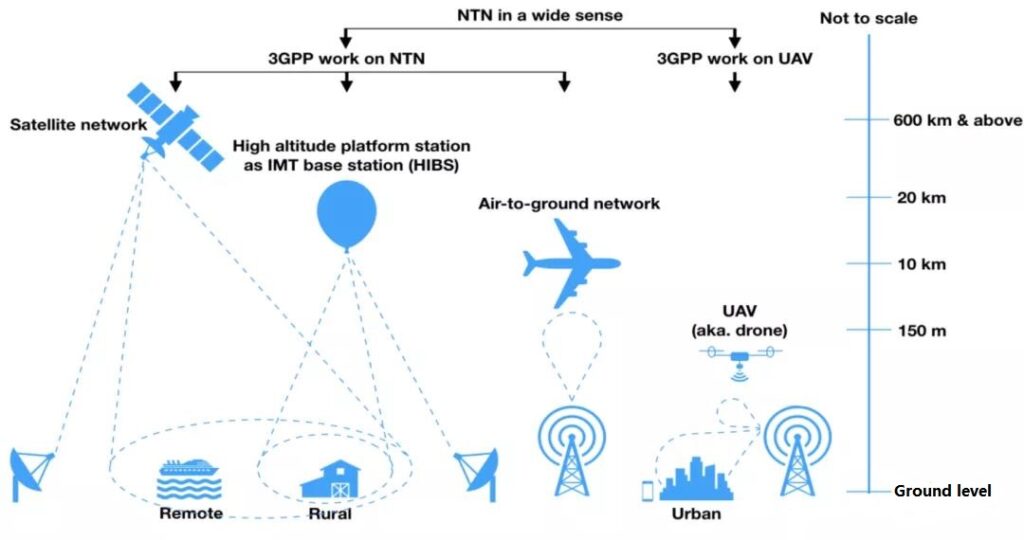
The ins and outs of the story are as follows: GlobalStart is an established company engaged in satellite communications. It has a history of many years in the industry and currently has its own satellite network. One of the main services of the satellite network is to communicate with the ground through satellite phones. The communication frequency band used by its communication system is the 1.6 GHz L-band for uplink. The downlink is in the 2.4835-2.495 GHz frequency band.
At the end of last year, 3GPP added 2.4835-2.495 GHz to the 5G frequency band, called the n53 frequency band. Combined with the non-terrestrial communication network part that 3GPP will release in Release 17. This means that you can use the n53 frequency band to communicate with GlobalStar’s satellite network for 5G communication. Of course, another way to use n53 is to authorize the use of the n53 frequency band from GlobalStar. It is used for terrestrial communication (that is, using the n53 frequency band for non-satellite communication).
Will the iPhone 13 support satellite communications?
At the beginning of this year, the X65 modem released by Qualcomm announced that it supports the n53 frequency band. In the recently released iPhone 13, Apple used Qualcomm’s X65 modem. The combination of these events led to the rumor that the iPhone 13 will support satellite communications.
In fact, even if Apple chooses to use the n53 frequency band support in the Qualcomm X65 modem to communicate with GlobalStar’s satellite network since the n53 frequency band is only the downlink frequency band of the network. It is necessary to add the L- Band support, while the support for L-band has not been officially confirmed by Qualcomm. In addition, satellite communications also have unique requirements for RF front-ends (including antennas, RF front-end modules, etc.), and it is not enough to have modems to support frequency bands. The antenna and new RF front-end modules will have a significant impact on the shape and cost of mobile phones. So it is reasonable that Apple does not intend to support satellite communications at present.
The fact that Apple iPhone 13 does not support satellite communications does not mean that large-scale commercial satellite communications are still far away. In fact, as satellite communications enter the new version of 5G standards and related technologies mature, we have the opportunity to see the real large-scale promotion of 5G+ satellite communications networks within a few years.
The application prospects of 5G satellite communication
Let us first look at the advantages and limitations of 5G satellite communications. The satellite communication here mainly refers to the two-way communication between the ground and the satellite, rather than unilaterally broadcasting signals to the ground by satellites such as GPS or Beidou. The main advantage of satellite communication lies in its wide coverage, basically without ground infrastructure (base station) support. Unlike traditional terrestrial wireless network communications, which need to build base station coverage first, satellite communications (mainly low-orbit satellites LEO) basically cover the world, and there is no need to build base stations. Therefore, the main application scenarios of traditional satellite communications other than 5G are Communication in places where base stations cannot be built such as the sea or the air (such as maritime telephones, etc.).
The main limitation of satellite communication lies in its limited channel capacity. In the two-way communication between the satellite and the ground, because the distance between the ground equipment and the satellite is very long, the loss of the wireless signal is very large. In other words, the signal-to-noise ratio of the communication is very low. The channel capacity is determined by the signal-to-noise ratio, so this determines the lower channel capacity of satellite communications. The low channel capacity of satellite communication means that high-speed communication cannot be provided to multiple users at the same time. For example, if n53+L-band is used, when many devices are connected at the same time, the communication code rate is estimated to be around 1-10kB/s.
5G satellite communications cover places that the base station cannot reach
The most direct application of 5G satellite communications for individual users is communications where the base station cannot reach. This first includes communications in some more remote areas (such as underdeveloped scenic spots, or on the sea). In fact, many outdoor enthusiasts currently have a demand for satellite emergency communications. This type of emergency communication does not require high communication speed. So 5G satellite communication should be able to meet the demand. In addition, 5G satellite communication is also an application point for communications on flights.
At present, many flights have provided WiFi services, and satellite communication is an important part of WiFi on flights. With the development of 5G satellite communications in the future, individual users on flights may be able to directly use 5G satellite communications by using frequency bands that do not interfere with the flight of the aircraft, instead of using the WiFi provided on the aircraft.
The Internet of Things is also one of the important application directions of 5G satellite communications. In 3GPP Release 17, satellite communications for the Internet of Things is an important research topic. In IoT applications, many times the networking scenarios are in areas that are not covered by the base station. At this time, the use of satellite communication will maximize the improvement of things. Network coverage without worrying about base station construction. For IoT applications, since the communication rate is inherently low, the current satellite communication speed can basically satisfy the application. The main problem is how to reduce costs. This includes how to reduce access costs at the satellite network side, as well as how to reduce the cost of antennas, chips, and batteries for terrestrial transceivers.
Opportunities brought by 5G satellite communications to the semiconductor industry
Once 5G satellite communications gradually become mainstream, the most important semiconductor incremental market lies in the RF front-end part. In order to ensure the success of uplink communication, we estimate that the end-side transmit power used for 5G satellite communication is much greater than other communications, so this puts new requirements on the power amplifier, and a separate power amplifier may be required.
In the downlink, due to the large signal loss of satellite communication, the requirements for the signal-to-noise ratio at the radio frequency end are very high. It is hoped that the lower the additional noise introduced by the radio frequency circuit end, the better. Therefore, the receiving end radio frequency front end (LNA, radiofrequency switch, etc.) used for 5G satellite communication may need a special design. Special processing may also be required in the radio frequency SoC. Due to the requirements for transmitting power and signal-to-noise ratio, 5G satellite communication antennas may also need to be specially designed. If you want to use the same antenna with other frequency bands, it may bring challenges to the design.
In contrast, the baseband processing part of the 5G satellite may be simpler. It is likely to use the existing 5G baseband to make some adjustments in the software to provide support.
Based on this, we believe that if 5G satellite communications can really be promoted. In summary, due to the large link loss of 5G satellite communications, simpler modulation methods are expected to be used. For the uplink, a power amplifier with high output power is required. But the demand for linearity may not be very high. For the downlink, there is a higher demand for the signal-to-noise ratio. A specially designed antenna is required, which may require antenna gain for the uplink and downlink.